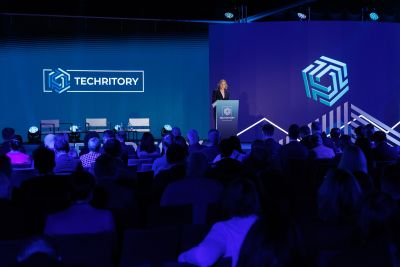
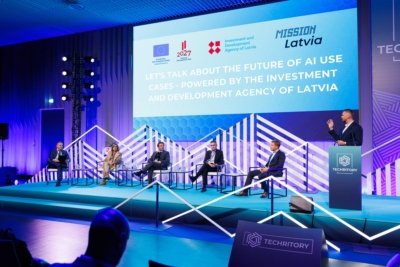
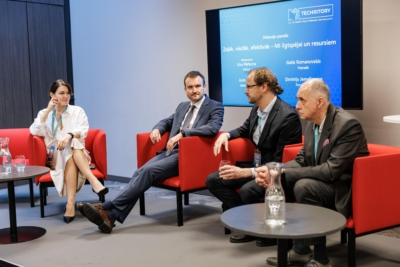
Mark your calendars: Techritory 2026 lands in Riga on October 21–22. This year’s theme is “Security and Prosperity Through Digitalisation and Connectivity.” Over 600 speakers and guests will join. Together, they’ll dig into topics like 5G/6G, AI, data centres, digital sovereignty, and defence tech.
Registration is free and open now— save your spot, then get ready for who’s on stage. Here are 11 speakers at Techritory 2026 you shouldn’t miss:
1. Mr. Tomas Lamanauskas
Tomas Lamanauskas is Deputy Secretary-General of the International Telecommunication Union (ITU), leading its work on mobilising investment in digital infrastructure and advancing digital resilience.
He has over 25 years of experience in telecoms and digital policy, having held executive-level positions across Europe, the Middle East, the Caribbean, and the Pacific, and holds master’s degrees from Harvard, London Business School, the University of the West Indies, and Vilnius University.
2. Mr. Yasushi Masaki
Yasushi Masaki became Deputy Secretary-General of the OECD in 2025, overseeing the organisation’s work on digital transformation and artificial intelligence.
His portfolio also spans trade, science and innovation, and he serves as the OECD’s representative to the Financial Stability Board. He brings over four decades of experience from Japan’s Ministry of Foreign Affairs, including major Free Trade Agreement negotiations like RCEP, and served as Japan’s Ambassador to the European Union and to Indonesia.
Hear Mr. Lamanauskas and Mr. Masaki:
Opening ceremony, on October 21, 09:00 – 09:20 (EET) Opening Ceremony Stage
About this panel: Bringing together perspectives from the ITU and OECD, the session will explore how digital infrastructure, connectivity, and emerging technologies can support Europe’s resilience and economic competitiveness. The discussion will also look at the investment, policy, and international cooperation needed to turn digital transformation into sustainable growth.
3. Ms. Erzsébet Fitori
Erzsébet Fitori is Executive Director of the Smart Networks and Services Joint Undertaking (SNS JU), driving 5G deployment and Europe’s technology sovereignty in 6G.
She previously led Vodafone Group’s engagement with EU institutions from Brussels and, before that, ran the FTTH Council Europe, growing its membership, revenue, and influence as chief executive.
Hear Ms. Erzsébet Fitori:
Welcome address on October 22, 09:40–09:50 (EET), Opening Ceremony stage
4. Ms. Michelle Iliev
Michelle Iliev has driven Moldova’s tech evolution since day one—from building out public e-services at the e-Government Center to growing the country’s tech talent pipeline through Tekwill.
As State Secretary for Digitalization and Innovation, she’s now steering the country toward a digital-by-default state and an innovation-led economy. Her portfolio spans AI, cybersecurity, and innovation policy, including Moldova’s alignment with EU frameworks like the AI Act, eIDAS 2.0, and NIS2.
5. Mr. Mohamed AlSharhan
Mohamed AlSharhan leads the World Governments Summit Organization as Managing Director at the UAE Prime Minister’s Office, shaping one of the world’s biggest platforms for government innovation.
Earlier, as Projects Manager at Dubai Future Foundation, he ran Dubai 10X and the FIRST Global robotics championship, drawing 191 teams from around the world.
He holds master’s degrees in engineering systems and leadership, plus a civil engineering background that grounds his big-picture thinking.
Speaking at last year’s forum, he put it simply: “The future of innovation won’t be decided by who spends the most or who invests the most, but by the most trusted partnerships between them.”
6. Ms. Carola Veit
Carola Veit has served as President of the Hamburg Parliament since 2011, a role she’s held for well over a decade in one of Germany’s key port cities.
A lawyer by training and an SPD member since 1991, she’s been a sitting member of parliament since 2004 and now also partners at BERNZEN Lawyers.
7. Mr. Peteris Ustubs
A Latvian diplomat, Peteris Ustubs has spent over three decades shaping European diplomacy, starting in the Latvian diplomatic service back in 1993.
His career has since taken him through some of the EU’s most senior posts, including Ambassador to Canada and Diplomatic Advisor to President von der Leyen. Since 2022, he’s directed the European Commission’s work across Asia and the Pacific, and oversaw the Middle East portfolio until 2025.
8. Dr. Juris Binde
Dr. Juris Binde has led LMT, Latvia’s biggest mobile operator, as President and Chairman of the Management Board for over three decades, pushing the country’s telecom sector into the Industry 4.0 era.
He holds a PhD in Economics and has authored more than 40 scientific publications. In 2025, he was elected an Honorary Member of the Latvian Academy of Sciences, which is one of his several honours that also include Latvia’s Order of the Three Stars and Sweden’s Order of the Polar Star.
Hear Dr. Binde and Mr. Ustubs:
European Digital Partnerships for Development on October 21, 11:00 – 11:50 EET, Policy&Strategy Stage
About this panel: The discussion will explore how Europe can strengthen cooperation with markets beyond the EU while creating new opportunities for European technology companies and services internationally. It will consider how partnerships and policy can help European businesses compete and expand globally.
9. Mr. Nicolai Mohr Balle
Nicolai Mohr Balle directs Digital Faroe Islands, where he’s led the national rollout of digital infrastructure from the ground up, including the Faroese eID, the national citizen portal, and digital wallet solutions.
He previously held a leadership role at the Faroese Ministry of Health and Social Affairs, but today, he shapes the islands’ approach to AI and international cooperation on digital identity.
10. Mr. Andris Gailītis
Andris Gailītis has spent over 25 years building the Baltic region’s data center backbone, starting as CTO of DEAC in 1999 before becoming CEO in 2005. As CEO of Delska, he now leads six data centers across Latvia and Lithuania with 19 MW of capacity.
Under his leadership, Delska recently launched a new 10 MW AI-ready facility in Riga, positioning the region as a serious player in Europe’s AI and cloud economy.
Hear Mr. Andris Gailītis:
European Data Centres at Scale on October 21, 15:00 – 15:50 (EET), Policy & Strategy stage
About this panel: As demand for AI and cloud infrastructure grows, the discussion will examine what it takes for Europe to expand its data centre capacity while maintaining competitiveness and digital sovereignty. It will also explore the potential of regions such as the Baltics, alongside the challenges of energy availability, costs, and Europe’s relationship with global hyperscalers.
11. Mr. Peter Stuckmann
Peter Stuckmann heads the unit for connectivity policy and legal framework at DG CONNECT, currently coordinating the EU’s Digital Networks Act initiative. Before that, he led the European Commission’s 5G policy and served as Interim Director of the 6G SNS Joint Undertaking.
His earlier work includes coordinating the Digital Single Market Strategy and the EU R&D program that shaped 4G standards, giving him a hand in nearly every generation of European mobile policy since.
Hear Mr. Stuckmann:
Deep-diving the Digital Networks Act on October 21, 16:00 – 16:50 (EET), Policy&Strategy Stage
About this panel: The panel will bring together policymakers, regulators, telecom operators, and Big Tech to examine whether the Digital Networks Act can deliver a more competitive and investment-friendly European connectivity market. Expect debate around spectrum policy, regulatory harmonisation, infrastructure investment, and the respective roles of telecom operators and major technology platforms.
And that’s just 11 of the many voices you’ll hear this October!
5 more panels not to miss at Techritory 2026
1. Defence Technologies at Scale or Innovation Without Deployment on October 22, 10:30 – 11:20 (EET), Innovation & Technology Stage
About this panel: Europe has no shortage of promising defence technologies, but turning successful prototypes into solutions that can be produced and deployed at scale remains a major challenge. The panel will explore procurement, financing, stockpiling, and rapidly changing battlefield needs, as well as how defence companies can grow and export without compromising sensitive technologies.
2. Satellite Connectivity in Europe on October 21, 11:00 – 11:50 (EET), Innovation & Technology Stage
About this panel: With US players still dominating satellite connectivity, the panel will examine where Europe fits into the rapidly evolving market and whether emerging European alternatives can offer a credible path towards greater autonomy. The discussion will also tackle the business case for satellite connectivity, spectrum and regulatory questions ahead of 2027, and how telecom operators should respond as satellite and terrestrial networks increasingly converge.
3. EU Tech Resilience & Sovereignty Session on October 22, 10:30 – 11:40 (EET), Policy&Strategy Stage
About this panel: What does digital sovereignty actually mean for Europe: owning its technology, keeping companies and data within Europe, or simply ensuring that critical systems remain resilient regardless of who provides them? The panel will explore the trade-offs between technological independence and global cooperation, including whether open-source technologies and stronger resilience mechanisms could offer a more realistic path forward.
4. Europe’s Digital Identity Reality Check on October 21, 15:00 – 15:50 (EET), Innovation & Technology Stage
About this panel: As European countries prepare to roll out digital identity wallets, the challenge is shifting from regulation to implementation, with Member States moving at very different speeds and following different approaches. The discussion will examine interoperability, cybersecurity, privacy, and perhaps most importantly, how to convince people to actually adopt and use the new wallets
5. Evolution of 5G to 6G on October 21, 17:00 – 17:50 (EET), Innovation & Technology Stage
About this panel: As the telecom industry moves towards 6G, the discussion will ask what the next generation of connectivity needs to deliver and what lessons should be learned from the rollout and expectations surrounding 5G. It will also explore the role of governments and regulators, and how AI and automation could fundamentally change how future networks are built and operated.
Techritory 2026 runs in Riga and online, so register for free and see the full agenda to start planning your time.